
This year, Affirmity was a sponsor of the HR Research Institute’s State of Legal and Compliance white paper. The 44-page report examines organizations’ compliance readiness and recommends practical steps HR leaders can take to move towards true compliance capability. In this blog post, we’ve assembled a look at some of the report’s key insights.
1) Pay Equity and Pay Transparency Top the List of Most Difficult to Comply With U.S. Employment Laws
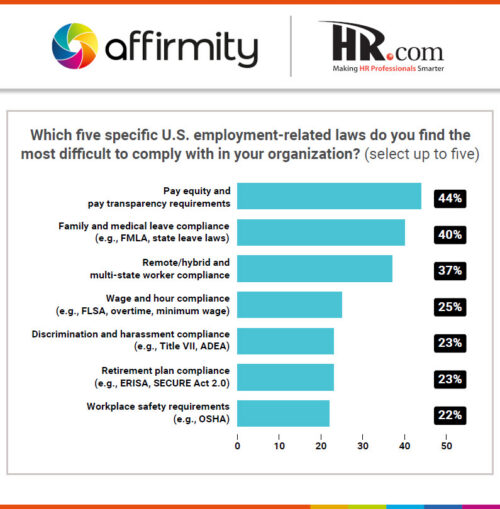
The report’s respondents were asked which U.S. employment-related laws they found the most difficult to comply with. Pay equity and pay transparency came out on top—chosen by 44% of respondents. This perhaps reflects the currently fragmented nature of these laws, where individual states have different implementations, and even determining which laws apply to your organization requires you to keep track of differing thresholds and employee locations. Notably, 37% of responses named remote/hybrid and multi-state worker compliance, demonstrating how this decade’s new working patterns have added complexity to compliance.
The only other employment-related law identified as difficult by more than a quarter of respondents was family and medical leave compliance. 23% of organizations find discrimination and harassment compliance difficult.
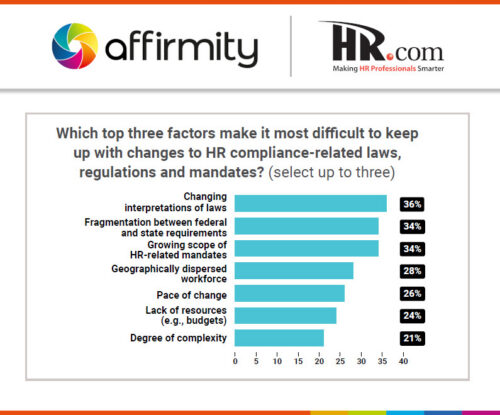
A later question dives into some of the factors that make it difficult for organizations to keep up with their compliance obligations. Though there seems to be a reasonably large amount of variance here (with no one factor scoring featured in more than 36% of responses, but only 4% claiming no factors make compliance difficult), the top results appear somewhat symptomatic of the current climate. Changing interpretations of laws (36%) and the fragmentation of federal and state requirements (34%) are apparently greater factors even than perennial issues such as the pace of change (26%), and lack of resources (24%). The growing scope of HR-related mandates also scores highly (34%)
DOWNLOAD OUR PAY EQUITY INFOGRAPHIC | ‘Pay Equity Reporting Around the World’
2) Anti-Discrimination and EEO Compliance Are Still a Top 4 Compliance Priority
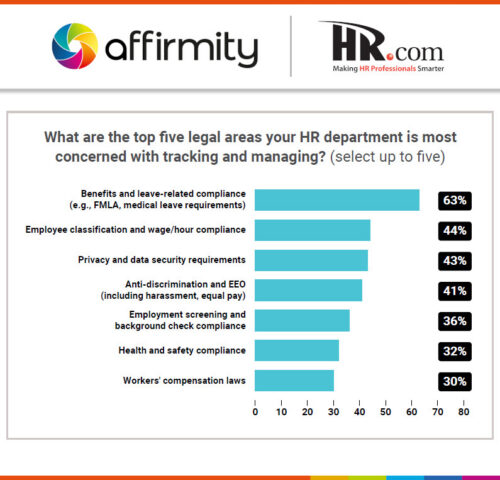
This year’s report shows that nearly two-thirds (63%) of HR departments are most concerned with tracking and managing benefits and leave-related compliance. From our own perspective, we feel it’s significant that 41% of HR departments put anti-discrimination and EEO (including harassment and equal pay) in their top five concerns (ranking fourth overall). This is ultimately as expected: though 2025/26 executive orders have targeted “DEI”, messaging from the current administration still emphasizes bedrock EEO and anti-discrimination laws, such as Title VII, VEVRAA, and Section 503, which require tracking and management to ensure compliance.
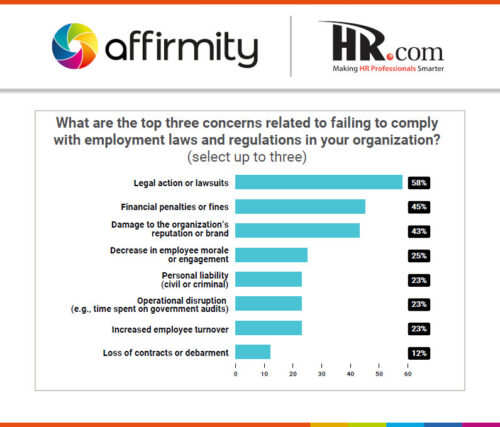
A question later in the report provides insight into what organizations worry most about when it comes to compliance failures. While all of the listed consequences are potential outcomes on some level, it’s interesting that “legal action or lawsuits” comes out on top (identified as a top-three concern by 58% of respondents) in this moment.
From an anti-discrimination compliance perspective, the threat of legal action is particularly prominent right now: both in the form of the DOJ’s anticipated action against “Civil Rights Fraud” via the False Claims Act, and the likely increase in legal action brought by private individuals and their lawyers. While lawsuits have doubtlessly always been something everyone would rather avoid, perhaps they’re such a large concern because it’s now less clear where legal action may come from, and also less clear how to defend against it.
MORE ON THE CIVIL RIGHTS FRAUD INITIATIVE | ‘The False Claims Act: Details Emerge From DOJ at Federal Bar Association Conference’
3) Organizations Feel Well Prepared for Compliance, But Lack the Proactive Stance That Would Signal Real Program Maturity
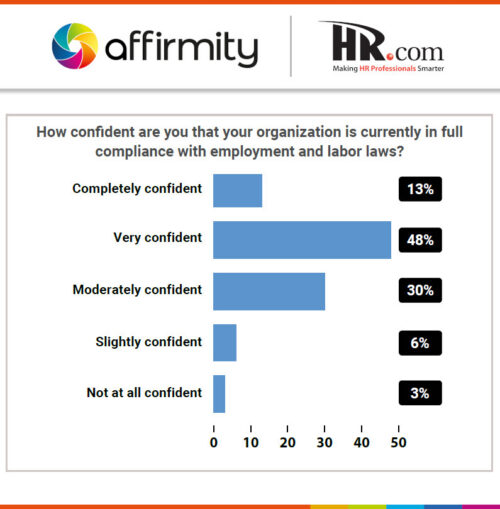
The report’s writers have placed particular emphasis on what they feel is a confidence gap between perceived compliance readiness and “proactive maturity”.
The story here is that 61% claim to be completely or very confident that their organization is currently in full compliance with employment and labor laws (and a further 30% at least moderately confident). However, when respondents were asked to describe the compliance processes they currently use, only a third (32%) had a sufficiently “proactive” approach that the report would consider adequate for that degree of certainty. These key compliance processes were:
- Documented processes
- Proactive monitoring
- Risk assessments
Based on this, the report warns that “many organizations appear assured of their current compliance position despite relying on systematic or documentation-based approaches that may not fully account for emerging legal risks”
4) Compliance Is a Time-Sink for HR, and Automation and Other Technologies Aren’t Being Utilized to Reduce This Drain
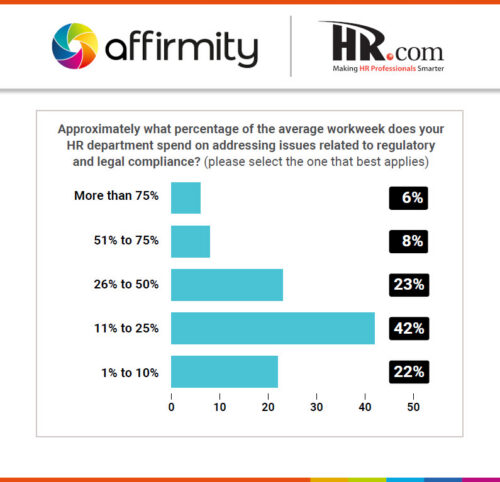
Around 78% of HR departments spend at least 11% of their average working week addressing regulatory compliance issues. Over a third devote more than 25% of their time to this purpose. While this is clearly an important area to focus on—and bearing in mind that the growing scope of HR’s remit is one of the biggest challenges for teams trying to keep up with their compliance obligations—organizations need to be certain that this is an appropriate emphasis. Do teams have access to resources and technologies that could reduce time spent on compliance? Or is this just “how long it takes?”
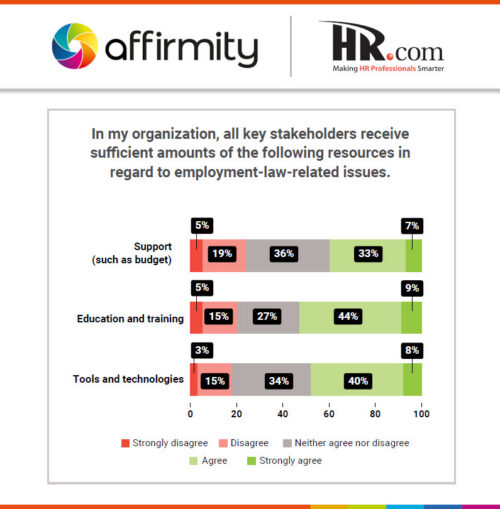
From the perspective of the report, though more organizations would answer that they have sufficient budget, education, training, tools, and technologies, there’s still around 20 to 25% of organizations that feel all these resources are lacking in their business. There’s also a further third who neither agree nor disagree—such teams are likely not struggling to prepare, but they’re also unlikely to be in a position where they can evolve to be more proactive and create a sustained compliance capability.
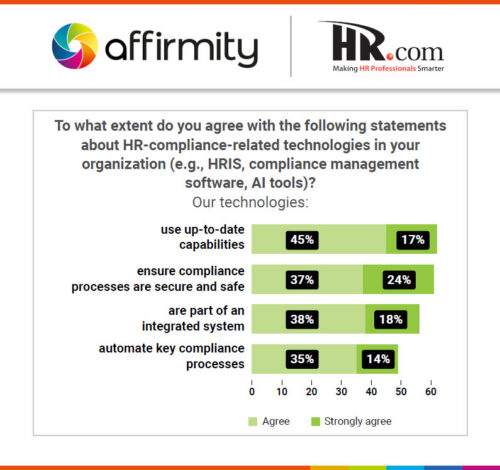
A majority of respondents (62%) agree or strongly agree that their compliance technologies use up-to-date capabilities, and a further 61% feel that those same technologies ensure compliance processes are secure and safe. The percentage who say their technologies allow them to automate key compliance processes is reasonably high (49%), but this does leave a little over half facing software limitations that could potentially reduce time spent on compliance.
GET THE RIGHT SOFTWARE IN YOUR CORNER | ‘Affirmity Launches Talent Decisions Software Module for Data-Driven and Defensible Processes’
5) HR Teams Increasingly Expect AI to Figure Into Their Processes Soon
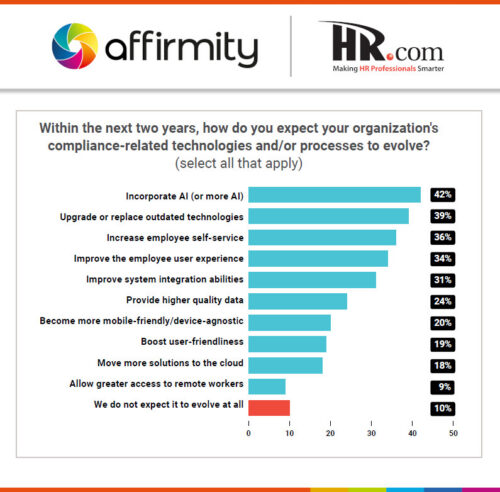
This year’s report evidenced growing anticipation of AI proliferation. 42% of respondents said they expect their organization to incorporate more AI into its compliance-related technologies within the next two years. This is almost double the 22% of the 2024 report (continuing an upward trend since the 10% recorded in the 2023 report).
Other technology and process improvements anticipated by respondents include upgrades or replacements for outdated technologies (39%), improvements to system integration abilities (31%), and general improvements to data quality (24%). 36% also expect to increase employee self-service—providing another way for HR teams to reduce the considerable time they spend on compliance.
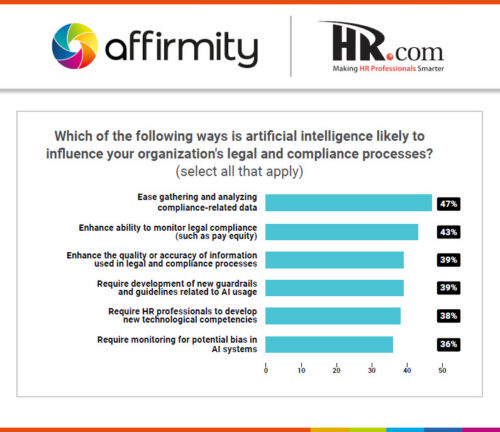
A later question in the report provides further clarity on AI’s expected role. 47% expect it will ease the gathering and analysis of compliance-related data. 43% expect it to enhance their ability to monitor legal compliance, and 39% expect it will enhance the quality and accuracy of the information used in legal and compliance processes.
LEARN ABOUT AI RISKS FOR HR COMPLIANCE | ‘AI Use in Employment Decisions and the Emergence of AI Bias Audits’
6) More Successful Organizations Excel In These Compliance Areas
This HR Research Institute report once again sorts respondents into “leader” and “laggard” groups based on their response to how they describe their organization’s current capabilities. Specifically, the leading 32% of respondents who have reached the final “proactive” stage in the report’s compliance maturity model are compared throughout the report to the 43% of respondents in the lowest “reactive”, “formalized”, and “documented” groupings. These comparisons reveal that compliance leaders are:
- Nearly three times more likely to have automated key compliance processes (45% versus 15%)
- More than three times more likely to operate integrated compliance systems (67% versus 21%)
- Nearly twice as likely to report being well prepared to manage compliance concerns (95% versus 58%)
- More than twice as likely to report that their compliance initiatives are well funded (67% versus 28%)
- Far more likely to rate their understanding of compliance developments as eight of ten or higher (85% versus 40%)
- Twice as likely to be capable of quickly generating useful compliance reports (59% versus 26%) and get meaningful insights from their analytics solution (55% versus 25%)
Continue Reading About the State of Legal and Compliance 2026
This is just a top-level look at some of the insights we found most interesting in this year’s HR.com State of Legal and Compliance 2026 white paper—there’s plenty more to discover in the full 44-page white paper, including:
- Greater depth on all of the topics above
- Areas not covered in our highlights, such as how HR teams are maintaining their compliance knowledge, what the most common compliance auditing habits are, and whether organizations expect to place greater importance on legal compliance
- HRRI strategic recommendations in every major section
- 10 key takeaways from HR.com, with suggestions for how HR compliance teams should adjust their processes going forward
- And more!
Get your copy of the white paper today or get in touch to learn how we can help you strengthen compliance readiness in an increasingly complex regulatory environment.
About the Author
Grace Mazar oversees marketing at Affirmity with direct responsibility for go-to-market strategy, product marketing and positioning, demand generation, events, and digital marketing.
A seasoned B2B marketing leader with over 20 years of experience, Grace applies her deep industry knowledge and proven outcomes-based marketing tactics to reach and influence targeted audiences.