
2025 and its many changes to the workforce compliance status quo are behind us, and while there will undoubtedly be more surprises to come, now is a good time to take stock of the current state of play. In this article, Christine Avila, a Manager of Consulting Services at Affirmity, examines what workforce compliance looks like after 12 months of policy shifts.
An Update on Section 503 and VEVRAA Thresholds
Ever since the end of Executive Order 11246-based affirmative action in January 2025, we’ve found ourselves periodically reiterating the fact that this doesn’t mean affirmative action in all forms is gone. Firstly, federal contractors have continuing obligations under Section 503 and VEVRAA. Secondly, there are state-level affirmative action laws to consider, among other state-level compliance laws of note.
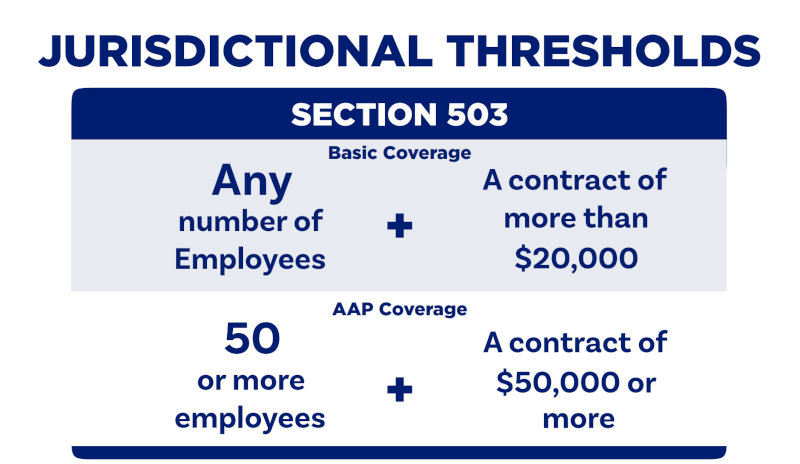
Notably, the basic coverage threshold for Section 503 was updated in late 2025: employers with any number of employees and a contract (or contracts) valued at more than $20,000 (formerly $15,000) must prohibit employment discrimination against qualified individuals with disabilities. The threshold for having to create and operate a written affirmative action program remains at least 50 employees, and a contract (or contracts) of $50,000 or more.
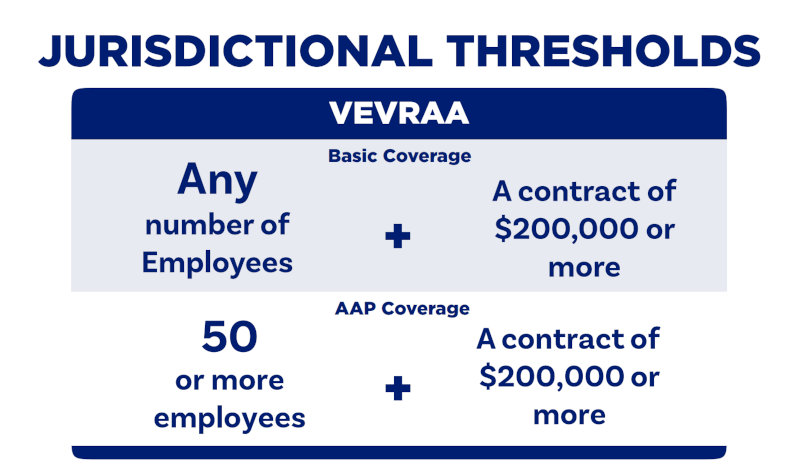
The VEVRAA thresholds were also updated in late 2025. Basic coverage now applies to all employers with $200,000 in federal contracts (formerly $150,000). Employers who reach this value threshold and have 50 or more employees must also create and operate a written affirmative action program.
LEARN ABOUT AN EMERGING AREA OF COMPLIANCE | ‘AI in Hiring: Which U.S. States and Cities Have Already Passed Regulations?’
Government Agency Composition in 2026
Last year saw a large volume of compliance-related Executive Orders (EOs) issued by the new administration. It also promptly initiated the process of “streamlining” governmental agencies. As a result, there’s a possibility that the OFCCP’s remaining compliance oversight (currently just the Section 503 and VEVRAA measures explained above) may shift to the Equal Employment Opportunity Commission (EEOC) and/or VETS within the Department of Labor. This would require Congressional approval.
In October 2025, the US Senate approved Brittany Panuccio as an EEOC Commissioner. The agency had lacked a quorum since the removal of two commissioners in January, so with the Republican majority that the appointment establishes, the agency is now once again able to:
- Establish agency priorities
- Release enforcement guidance
- Resume litigation on topics that the administration considers priorities
So what’s likely to be on the EEOC’s agenda? Clearly, based on the precedent set by EO 14281 (Restoring Equality of Opportunity and Meritocracy) and actions already taken against universities, DEI programs will be under intense scrutiny. Naturally, organizations are advised to take another look at their programs and consult with legal counsel to ensure they’re meeting the guidelines that have already been published, and adjusting when new guidance is published.
In this new EEOC regime, particular attention will be given to cases where diversity goals are a factor in intentional or unintentional discrimination. Programs motivated by race or gender, even under the banner of inclusion, must be re-evaluated for Title VII compliance.
We can also expect to see stronger enforcement around “reverse discrimination” after the Supreme Court’s June 2025 ruling that plaintiffs alleging workplace discrimination under Title VII are not required to meet a heightened evidentiary standard just because they have “majority-group” status.
However, we’re also anticipating reduced enforcement and outreach, with the EEOC expected to pursue fewer lawsuits and become more of an administrative body.
MORE FROM THE BLOG | ‘Life After EO 11246: Why and Where Workforce Demographic Data Is Still Required’
The EEOC’s New Enforcement Vision
With contractors no longer required to maintain affirmative action plans for women and minorities, they may soon be required to certify that their employment actions are free from discrimination and comply with all federal civil rights laws. At the time of writing, the exact requirements for certification have not been explained, but we anticipate certification will begin in 2026.
Regardless of the detail, we can broadly expect the certification requirement to become the new enforcement trigger, with a contractor’s compliance statement functioning as a binding attestation under Title VII and the False Claims Act (FCA). Then, if the government later investigates an organization and finds that employment decisions were influenced by protected characteristics and that the certification was false, the organization may face both civil rights liability and potential FCA exposure.
With the structure that compliance evaluations provided gone, the EEOC and DOJ will initiate investigations based on certification data, whistleblower or public complaints, and inconsistencies in statements rather than audit activity. This could allow the agencies to act more swiftly—audit processes were lengthy, after all—and avoiding an EEOC settlement doesn’t necessarily mean you’re safe, as you may separately come under scrutiny for submitting a false attestation according to the False Claims Act. With organizations prosecuted under the FCA liable for three times the government’s damages plus an inflation-linked penalty (currently $28,619), this is no empty threat.
READ MORE ABOUT THE FALSE CLAIMS ACT | ‘The False Claims Act: How DEI Risk Is Evolving, the Hefty Fines the DOJ Is Threatening, and How Affirmity Can Help’
Preparing for the Emerging Regulatory Landscape
Going forward, we recommend that federal contractors take the following steps in order to stay compliant:
- Review your hiring and promotion processes to ensure they’re neutral, merit-based, and compliant with Title VII
- Review your DEI and employee engagement programs to ensure they are neutral, merit-based, and compliant with Title VII
- Train leadership and HR staff on how initiatives can continue to operate while remaining within federal laws
- Continue to document your decisions, policies, and key data points in order to demonstrate compliance and the validity of claims made during self-certification
- Engage legal counsel and compliance consultants
Keep Exploring This Topic—Download the Ebook
This article is an extract from our ebook, “Workforce Compliance in 2026: The Strategies Required to Thrive,” a comprehensive guide to the shape of compliance in 2026. In addition to the insights above, you can also expect to find:
- A reminder of continuing federal and state obligations
- Further advice on preparing for the emerging regulatory landscape
- Guidance on monitoring non-discrimination and Title VII compliance
Prepare your non-discrimination efforts for future scrutiny. Please get in touch to learn more.
 About the Author
Christine Avila, Manager, Consulting Services, has been with Affirmity since 2010. She manages a team of consultants and advises clients in a variety of industries on affirmative action, equal employment opportunity, and diversity issues.
Prior to joining Affirmity, Ms. Avila had seven years of compliance experience as well as four years of recruiting experience for companies in the media and finance industries. Ms. Avila has served on the North Texas Industry Liaison Group (NTILG) Board since 2011.