
The EEOC once again has a quorum, and the agency has been clear about its vision for enforcement. In this article, Christine Avila, a Manager of Consulting Services at Affirmity, looks at the continuing legality of adverse impact analysis, and explores your options for monitoring your programs while maintaining compliance.
It’s important to remember that many of the EEOC’s key laws are still in effect, as they have been for decades:
- Title VII of the Civil Rights Act of 1964
- Equal Pay Act of 1963
- Americans With Disabilities Act (ADA) 1990
- Age Discrimination in Employment Act (ADEA) of 1967
The purpose of these laws is, of course, to prohibit discrimination in employment based on specific protected characteristics, thereby promoting a fair and equitable workplace for all individuals. And this applies to all aspects of employment, from hiring to firing, promotions to demotions—across compensation, job assignments, training, benefits, and the other terms and conditions of employment.
A key concept that also remains essential in complying with these laws is adverse impact: under the Uniform Guidelines on Employee Selection Procedures, adverse impact is “a substantially different rate of selection in hiring, promotion or other employment decision which works to the disadvantage of members of a race, sex or ethnic group.”
The Uniform Guidelines were first established in the 1970s, and they referenced the 80% or “four-fifths” rule. This tasked employers to look for instances where the selection rate for one group was less than 80% of another—and it remains a valid test for quick identification of adverse impact, before applying more robust Standard Deviation and Fisher’s Exact statistical tests.
HERE’S WHY YOU SHOULD STILL COLLECT DATA | ‘The Strategic Case for Collecting and Analyzing Workforce Demographic Data’
Executive Order 14281 and the Status of Disparate Impact
Issued in April 2025, EO 14281 (“Restoring Equality of Opportunity and Meritocracy”) was notable (among other things) for taking aim at disparate impact liability:
“Disparate-impact liability has hindered businesses from making hiring and other employment decisions based on merit and skill, their needs, or the needs of their customers.”
Unsurprisingly, this left a number of employers wondering whether it was even legal for them to be looking for disparate impact within their own organizations. It must therefore be emphasized that the executive order is only meant to instruct the EEOC and other federal agencies to cease enforcement activities related to disparate impact. Otherwise, disparate impact:
- Remains codified in law via the 1991 amendment to the Civil Rights Act of 1964
- Was upheld by the Supreme Court in Griggs v Duke Power Co. (1971) and Smith v City of Jackson (2005)
- Is likely to remain in use by states pursuing state-level charges, and by attorneys filling the void left by the EEOC on behalf of their plaintiffs
Furthermore, we would contend that investigating disparate impact is not contrary to the goals of this or other recent executive orders. Doing so ensures that your operations, policies, procedures, and methodologies do not unintentionally discriminate by creating unnecessary barriers, hardships, or requirements that disproportionately affect a protected class.
While the implication of the EO 14281 statement quoted above is that impact analyses are used to influence individual selection decisions as they’re being made, their actual usage is purely retrospective. When Affirmity performs adverse impact analyses, we typically look at transactions over a six- or twelve-month period to identify statistically significant indicators of potential barriers impacting particular groups.
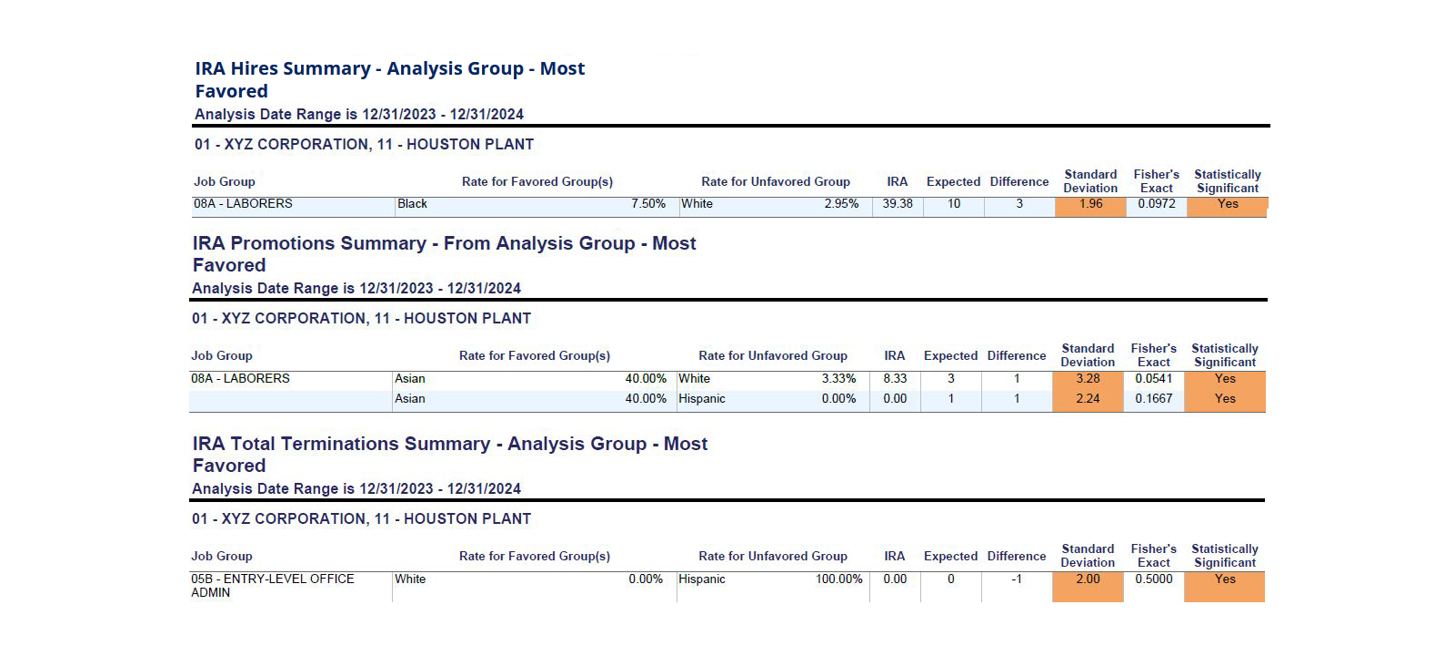 The screenshot above shows three examples of adverse impact analysis reports—for hires, promotions, and terminations. In all three examples, a retrospective, year-long date range is used, and Standard Deviation and Fisher’s Exact statistical tests have been performed for a given job group. Based on these results, the next step would be to investigate each group further.
SEE WHAT THE INDUSTRY IS SAYING | ‘6 Highlights as National ILG Panel Members Look Back—and Ahead—at Trump Administration 2.0’
What to Do When Adverse Indicators Are Discovered
Once you have identified signs of adverse impact in specific groups, your next steps will depend on which specific selection decision you’re reviewing.
Initial Data Validation for Hires
- Reconcile hires to applicants (only include external applicants) and review that all transactions are accurate
- Ensure you have all supporting documentation for those interviewed and can effectively defend those not selected
- Ensure you have supporting documentation for each step of the selection process
- Consider running the analysis by requisition or job title
- Perform a steps analysis
If adverse impact is found in selection decisions, employers are required to perform a steps analysis in order to determine which step(s) of the selection process caused adverse impact. This is only possible once applicants and hires have been properly reconciled and all applicants have been assigned a final step and disposition reason.
Initial Data Validation for Promotions
- Ensure that there are no performance issues for those who have been promoted. If there are, be able to explain the promotion
- Ensure there is sufficient documentation to support the promotion decisions made
- If there are competitive promotions, make sure there is documentation about the selection
- Verify the pool is accurate. Exclude external candidates
- Ensure you have a written explanation of how the organization defines a promotion and make it available
Though a steps analysis isn’t strictly compulsory, it may still be useful for helping you understand where an adverse impact originates in your promotions process.
Initial Data Validation for Terminations
- Review a separate analysis for voluntary versus involuntary terminations
- Review exit interview notes to determine reasons for adverse impact in voluntary terminations and investigate as needed
- Make sure you have documentation to support reasons for involuntary discharges, and determine if people are treated equally in other classes for the same offense
As with promotions, it can be useful to apply a steps analysis to further investigate adverse impact in your terminations process, though such an analysis isn’t strictly required.
Title VII and Test Validity
Another aspect of compliance that remains unchanged by recent developments is the legal requirement to ensure test validity. Title VII prohibits employers from using neutral tests or selection procedures that have the effect of disproportionately excluding persons based on covered classes, where the tests or selection procedures are not “job-related and consistent with business necessity.”
Establishing test validity means gathering evidence that any tests used in your selection processes are capable of predicting job behaviors and performance, and relevant in covering important aspects of a job. If a test is shown to cause adverse impact, employers must take steps to determine whether an alternative selection procedure could be employed (and thereafter adopted).
Validation should be revisited periodically: employers should consider any changes in job requirements over time, and update their test specifications and selection procedures accordingly. Furthermore, if purchasing a test from a vendor that claims to have already done a validation study on the test, employers must still review the test again in order to validate it with the organization and the specific jobs it will be used for.
ANOTHER ARTICLE YOU MAY FIND USEFUL | ‘The Shifting Year in the Life of a Workforce Compliance Professional: 7 Key Non-Discrimination Program Responsibilities’
How Your Organization Will Thrive in 2026
2026 will doubtlessly present new challenges and opportunities, but the state of compliance isn’t entirely unrecognizable in this moment. EO 11246 may be gone, and federal contractors may no longer be preparing female and minority-based affirmative action plans, but many critical employment laws—Title VII, the Equal Pay Act, Section 503, and VEVRAA—remain in place, and any organization ignoring them is taking a massive risk.
While not quite “business as usual”, you still need to be doing a lot of the same analysis in 2026 that you were doing before. You also need to look at your DEI and other employee engagement programs and ensure that they’re explicitly open to everyone. This process of self-examination should be done under attorney-client privilege, and involving your legal counsel, and Affirmity is also on hand to work with you and your legal counsel to ensure that these sensitive analyses are performed the right way.
Learn More About Your Essentials for 2026—Download the Ebook
The content above is taken from our ebook, “Workforce Compliance in 2026: The Strategies Required to Thrive,” a comprehensive guide to the shape of compliance in 2026. In addition to the insights above, you can also expect to find:
- A reminder of continuing federal and state obligations
- The latest jurisdictional thresholds for Section 503 and VEVRAA
- What new appointments mean for the EEOC and its agenda
- Advice on preparing for the emerging regulatory landscape
Prepare your non-discrimination efforts for future scrutiny. Please get in touch to learn more.
 About the Author
Christine Avila, Manager, Consulting Services, has been with Affirmity since 2010. She manages a team of consultants and advises clients in a variety of industries on affirmative action, equal employment opportunity, and diversity issues.
Prior to joining Affirmity, Ms. Avila had seven years of compliance experience as well as four years of recruiting experience for companies in the media and finance industries. Ms. Avila has served on the North Texas Industry Liaison Group (NTILG) Board since 2011.