
Employment law has always been in a state of flux, but it seems like the pace of change has never been greater than in recent months. As federal law has pulled back in regulatory areas we’ve long taken for granted (and opted for a light touch on emerging legal areas, such as AI use), states and localities are stepping into the void. In this article, Roy Zambonino, Senior Solutions Consultant at Affirmity, discusses Employment Law Navigator, a new Affirmity product that helps you keep track of this increasingly fragmented picture.
The Current Challenge for Multi-State HR Compliance Teams
How do you currently keep track of the existing and newly emerging employment laws that apply to your organization everywhere it operates? Many organizations have to cast a wide net in order to get a complete picture: you may have legal alerts set up, perhaps a system of Google alerts, and maybe numerous legal newsletter subscriptions. You may be getting information from legal counsel either outside or in-house, and you may be trying your best to track it all with a system of spreadsheets and inboxes.
Trying to understand it all can be very challenging, and the difficulty is arguably less about having too little information—it’s more about having so much information to sift through that you struggle to figure out what applies to you, or to avoid having important updates falling through the cracks, or to easily recall that information whenever it’s relevant.
The challenge that this fragmentation presents can come to a head in multiple ways. HR could get an inquiry from an employee, or you could be opening a new office. Something outside of your routine processes happens, and you have to research what the law actually is in that jurisdiction. That research could take the form of Google searches, asking AI, or speaking with counsel. You get all that information; some of it comes with additional costs and long lead times, and you have to invest time to interpret how it applies.
And not only is this a challenge that comes up for you periodically, but it’s also likely experienced across many different teams, perhaps even with differing interpretations. Furthermore, whenever such information enters your business, there’s a cascading effect of subsequent actions—policies to update, new handbooks to push out. In a large enough business, that’s hundreds or even thousands of hours spent by multiple people trying to find and reflect this information.
AI large language models like ChatGPT, Claude, Gemini, CoPilot, and the rest have become a useful but problematic part of this picture, as they are in all domains. Sometimes they hit the mark, sometimes they create a convincing-sounding but ultimately false version of the facts. This doubt makes it essential to validate AI outputs with expert counsel, negating any time savings (and meaning you could basically cut AI out of the equation entirely).
AN AI MUST-READ | ‘A 4-Step Approach to Performing an AI Bias Audit’
What Does a Better Model Look Like?
The impulse to “just ask AI” speaks to the convenience currently missing from the compliance approach. Everyone wants to be able to go to a single place when they’re looking for information, for that one place to have all of the information they need, and for that information to be reliable. AI does some of this—and one advantage is it’s actually quite good at guiding you towards what your question actually is—but when information reliability is by far the most important factor, it obviously falls short.
The better model looks like this:
- All the answers you need in one place
- Every answer is pre-vetted by legal experts
- Plain-language explanations
- An easy-to-search legal library
- An AI component that can guide your questioning and get you instant answers, but is trained specifically on pre-vetted information
- New laws vetted and added in around two business days
- The ability to ask a human expert a legal question and receive a response in two business days
- A share function that allows you to assign compliance tasks to individuals on your team
- An array of tools for building handbooks, comparing different states, and performing common calculations
A new Affirmity product, Employment Law Navigator, follows this model. And while it won’t completely replace your legal team, it will help you lean on them less by giving you reliable answers to the vast majority of your questions (and a starting point for the small number of more legally complex questions that require input from counsel).
HAND-PICKED FOR YOU | ‘3 FAQs That Explore What Proactive Compliance Looks Like With Affirmity’s Talent Decisions Software’
Meet Employment Law Navigator
Employment Law Navigator is accessible through Affirmity’s Workforce Analytics and Compliance platform, just a single click away from the reporting tools and resources that users already work with in this system. Out of the box, it offers the following features:
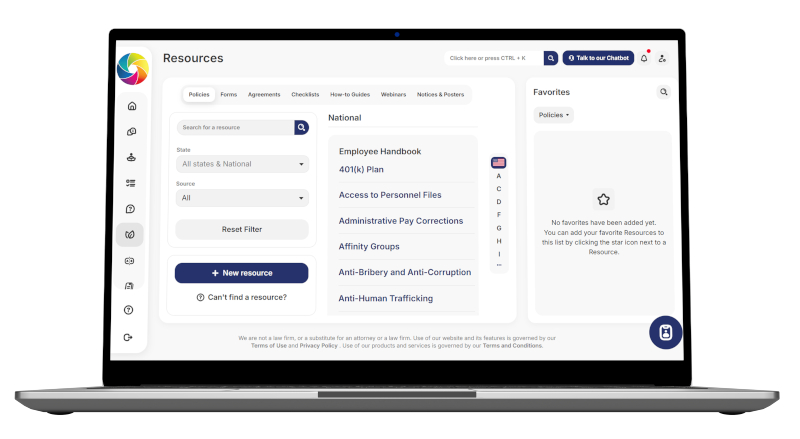
- AI Compliance Chatbot: Get fast, attorney-verified answers from a guided chat experience.
- Ask an Expert: Got a question the chatbot cannot answer to your satisfaction? Ask a legal expert and get an answer within two business days.
- Multistate Law Comparison: Quickly compare requirements across jurisdictions for key laws and legal topics.
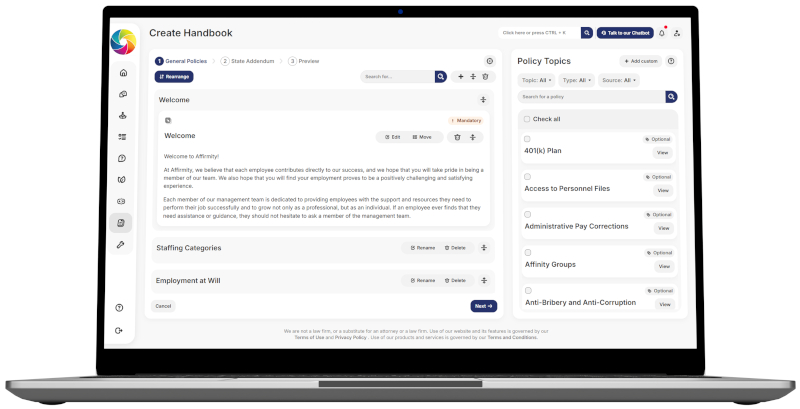
- Handbook Builder: Build new handbooks from scratch with the laws relevant in your industry and location, or upload your existing handbook and get an analysis of any gaps wherever you operate.
- Form and Policy Library: Kickstart new processes with a library of template forms and policy documents for common actions such as non-disclosure agreements, offer letters, and accommodations requests.
- Proactive Legal Updates: Employment Law Navigator’s legal database is typically updated within 24-48 business hours after laws change, as this time is required for attorney validation of the guidance. Set alerts for the laws that directly affect your organization, and view current and upcoming deadlines and announcements in a handy compliance calendar.
- Document Your Discoveries: Log actions, acknowledgments, and policy updates to support program defense with a robust audit trail.
- Unlimited Users: Keep large, distributed teams connected through the platform and assign tasks whenever needed.
All of these features come together to bring you a single place where you can understand what your organization needs to know about doing business wherever it operates. Employment law may not be getting simpler—all indications are that it’s only getting more complex—but Employment Law Navigator is designed to make the process of understanding everything as uncomplicated as possible.
EXPLORE MORE TOPICS ON OUR BLOG | ‘What the EEOC’s “Record-Breaking” 2025 Results Mean for Your Organization’
Get Employment Law Navigator
We’re excited to get you and your business up and running with Employment Law Navigator. Here’s how:
- Existing Affirmity clients: Please ask your account team how to add Employment Law Navigator to your current Affirmity solution.
- Prospective Affirmity clients: Please request a personalized demo of the broader Affirmity Workforce Analytics and Compliance platform—we’ll discuss your specific compliance needs and tailor our solution accordingly.
Further details can be found in this dedicated product sheet.
Affirmity Employment Law Navigator is now available. Please contact us today or speak to your Affirmity account manager to learn more.
About the Author
 Roy Zambonino is a senior solutions consultant at Affirmity. He is responsible for demonstrating and discussing Affirmity’s wide range of software, consulting services, and digital learning solutions with existing and prospective clients.
As a former project manager, Mr. Zambonino draws on the best practices he’s observed over the last 29+ years to help prepare and implement programs. This work has involved companies ranging in size from a few hundred to several hundreds of thousands of employees, and spans across many industries, including retail, construction, healthcare, banking, and finance. Mr. Zambonino has a Bachelor’s and Master’s degree in Business Administration.